
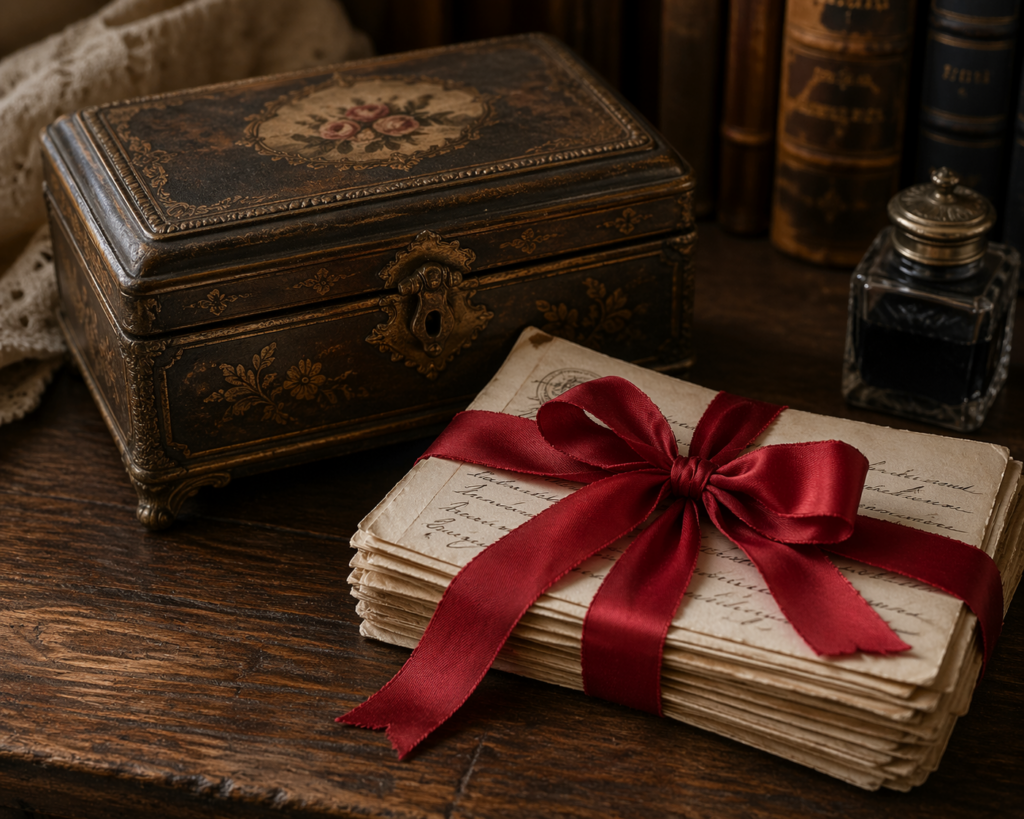
Every morning when I sit down at my dressing table, my grandmother is the first face I see.
Not a photograph. A letter. Framed, under glass, her handwriting across the page in that particular straight-forward cursive she used her whole life — the loops on the g‘s unfussy, the y‘s tailing off like they were in a hurry to catch up with the next word. I’ve read the letter hundreds of times. I still read it at least once a week.
Her name was Velda. And the reason I know so much about her — beyond being my “Grandmama” — is because of the letters.
The weekly round
Velda was a woman for whom weekly correspondence was not a hobby. It was a discipline. Every Sunday afternoon, after the dishes were done and the house had gone quiet, she would sit at her kitchen table with her good stationery and her blue fountain pen and write.
To her mother — my great-grandmother — who lived down in south Texas.
To her cousins, scattered from Texas to California, each of whom she treated like a sister.
To her in-laws in west Georgia.
And to her daughter — my mother — who in the 1960s was living abroad with our family in France, and later in England, raising small children in a rented house with uneven floors and the kind of kitchen that required you to befriend a coal stove.
My mother wrote back every week. The village in the Dordogne. The cobblestones in Oxford. The strange English phrases like “knock you up” meaning I’ll come by your house for a visit. The particular way my brother said bonjour with the most wildly American accent imaginable. Those letters landed in Velda’s mailbox every Tuesday or Wednesday, and by Saturday they had been copied out in part, or simply folded back into a new envelope and sent along — to her mother in Texas, to her cousins, to her in-laws, to anyone in the family who was hungry for news of the ones who had gone far.
This is the thing I want to say plainly: my grandmother’s house was a node. She was the clearinghouse. The family’s weekly life, lived in three countries and five states, passed through her kitchen table.
The letters that disappeared
The letters from France and England moved like rivers through the family. Cousin to cousin, aunt to aunt. Each reader added a note on the back, or tucked in a reply, or passed it along with thought you’d want to see this scribbled across the top.
Somewhere, at the far end of the network — at the last mailbox in the last kitchen in the last small town — the letters finally came to rest. And they were lost.
I grieved this for a long time.
But I’ve come to understand it differently. The letters were never meant to be archived. They were meant to be circulated. They did what they were sent to do. They kept a family from falling apart across an ocean. That is not a small thing, and the fact that the paper didn’t survive doesn’t mean the letters didn’t do their work.
What Velda left behind
When Velda died, we found her scrapbooks.
She had not saved the weekly letters from my mother — those had all been sent along. But she had saved the shared photographs. Black-and-white prints of my mother in a headscarf on a French hillside. My father in uniform standing proud. My brother at three, behind the wheel of the Jaguar. Each photograph carefully pasted onto thick black pages, each with a caption in Velda’s handwriting, every date precise.
And she had saved the other letters. The ones that stayed. Condolences. Announcements. Birth notices. Death notices. A Christmas letter from a cousin’s cousin that said simply, all well here, the baby is walking.
Those scrapbooks are how I know what my grandmother’s life looked like from the inside. And it is a specific kind of knowing — not family legend, not photographs alone, but her own voice beside the evidence, saying what she thought of it.
Aunt Miriam and the Carrollton paper
I cannot write about the letters in my family without writing about my great-aunt Miriam, who lived in Carrollton, Georgia, and who, in 1965, set off for Europe with her niece and a friend.
Their itinerary was ambitious by any standard — and only loosely tethered to a plan. They visited my family in France, rented a car, and promptly set off to see far more than they had originally intended. To solve the eternal tourist problem of finding their car in a crowded lot, they tied a small Georgia state flag to the antenna — a bold and distinctly Southern solution.
What they hadn’t planned on was crossing an international border without realizing it. As they rolled through what turned out to be a France-Spain checkpoint, uniformed guards began waving their arms and calling out to them with great urgency. The ladies, charmed and unhurried, simply waved and hollered a cheerful Southern hello right back. How friendly these Europeans were! So enthusiastic! The guards, apparently deciding that physics and goodwill were working against them, gave up — and dissolved into laughter as the little flag-flying rental car sailed through to the other side.
It was the kind of accidental adventure that only happens when you’re too cheerful to be stopped.
Miriam wrote home about all of it. And every letter she wrote was printed, verbatim, in the Carrollton, Georgia local newspaper.
Those letters are family lore now. They are read aloud at reunions. They are quoted when something goes sideways on anyone’s vacation. Miriam’s voice — musical, unhurried, delighted by her own predicaments — has outlived every one of the people she was traveling with.
What she understood, I think, is that a letter is a public thing. Even a private letter has an audience of more than one, because it will be kept, and reread, and eventually someone who was never meant to read it will. Miriam leaned into that truth. She wrote as if she knew her letters would be printed — and so they were.
The lesson I’ve taken from her: write the story as though someone you love will read it in fifty years. Because they will.
The letter beside my dressing table
The framed letter by my dressing table is a short one. Grandmama wrote it to me when I was a young woman, starting a career, making my way in life. In it, she told me that she was proud of me and had faith in who I was becoming, that she was thinking of me on that particular Tuesday.
There is nothing extraordinary in it. That is the whole point.
I read it every morning because her handwriting itself is the thing I need. The turn of phrase reminds me how she spoke. The way she crossed her t‘s reminds me she was patient. The way she ended the letter — all my love, Grandmama — is the closing I still hear in my head when I write my own.
When I sit down to write the fictional letters inside Letters from Caroline, that voice is what I am listening for. Not Velda’s exactly. But the particular music of a woman writing alone, at a kitchen table, to someone she loves.
If you have letters somewhere
Find them. Read them. Frame one, if there is one that deserves it.
And if you have someone you love who has gone far — a daughter, a mother, a grandchild, a sister — write them a weekly letter for a year. You do not have to say anything important. Mother didn’t. The letters mattered because they kept coming.
A weekly letter is a quiet act of devotion. It is the practice of staying.
Letters from Caroline arrives later this year. It is, in its way, a book about exactly this.
With love for the past,
Nancy