
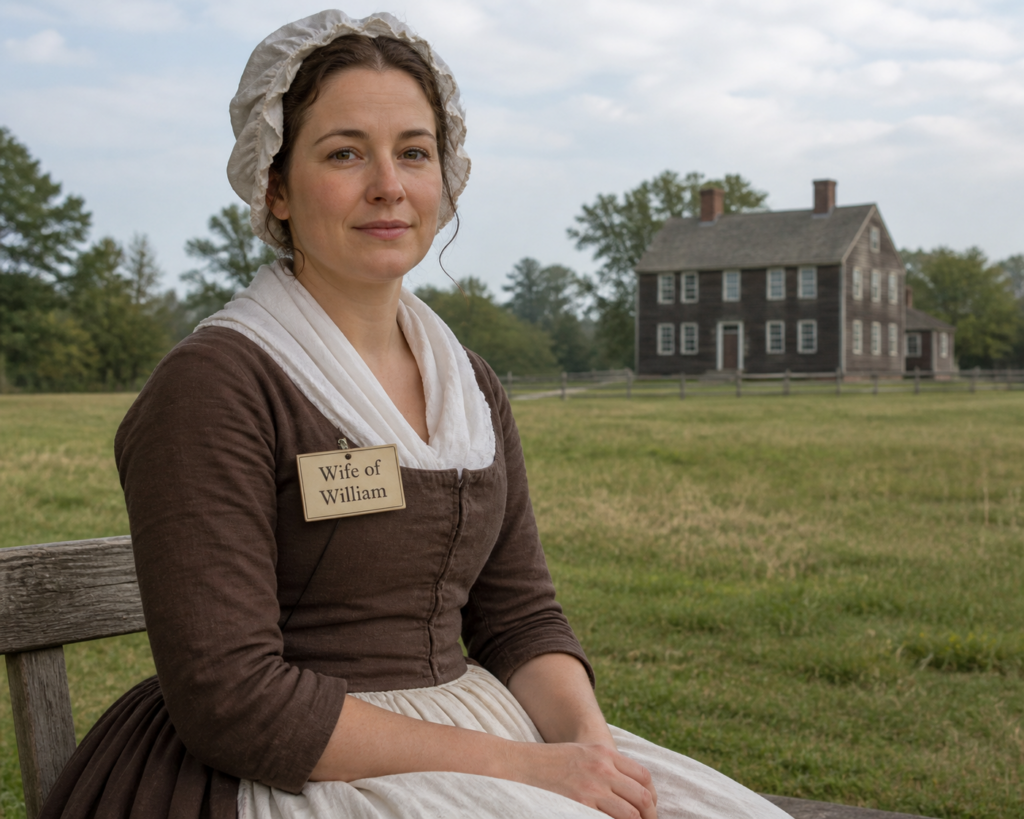
There is a woman in my family tree whose entire life — her personality, her choices, her voice — has been reduced to three words in a census record: wife of William.
She had a name. She had parents who chose that name for her, who called it across a yard or a field or a kitchen. She had a signature, somewhere. And then she married, and the record-keepers decided that William’s name was sufficient for both of them.
I have spent considerable time trying to find her.
The Name That Disappears
In historical research, the surname is the thread. Pull it, and a whole life unravels into the light — baptismal records, land deeds, letters, newspaper mentions, the small bureaucratic footprints that confirm a person existed and mattered. The surname is how history remembered people.
But for women, the thread was cut at marriage. Maiden names submerged into husbands’ surnames. Mothers became extensions of their children’s records. Grandmothers were listed by the names of the men they lived with, not the names they were born to.
This is why researching women’s lives requires a different kind of patience. You are not following a line — you are reconstructing one from fragments.
What a Name Can Hold
I have always been obsessed with surnames and it showed up again early in the research for Call of the Blackbird. The novel required me to understand not just events but people — their class, their origins, their sense of themselves. And surnames, I discovered, carry extraordinary information if you know how to read them.
A name can tell you where a family came from — the county in Ireland, the region of Germany, the village in England. It can tell you something about economic status, religious affiliation, the migration patterns of an entire people. Names cluster geographically. They carry the evidence of who moved and who stayed, who assimilated and who held on.
But what moved me most, in all my research, was what I found in the maiden names I was able to recover. The women who had been swallowed by their husbands’ records were, when I found their original names, suddenly distinct. Suddenly themselves. A maiden name is not just a name — it’s a lineage. A context. A reminder that a woman existed before she was a wife, and that her people had a story that ran parallel to and separate from the story she married into.
The Research That Changed a Character
There is a character in Call of the Blackbird who began, in my earliest drafts, as a secondary figure. She was defined almost entirely by her relationship to the men around her — as historical women often are in the records. Then I found her maiden name.
I won’t tell you which character, because I’d rather you discover her on the page. But I will tell you this: her maiden name led me to a family that had arrived in the American colonies in the 1600s, that had lived through events I had not intended to put in the book, that carried a grief that turned out to be precisely the grief I needed her to carry. Her name gave me her history. Her history gave me her.
This is the gift that research sometimes offers. You go looking for one thing and find the person you didn’t know you were missing.
The Naming Traditions Worth Knowing
For anyone doing surname genealogical research — and I know many of my readers are, because you write to tell me so — a few naming patterns I’ve found worth understanding:
In many Southern families of the eighteenth and nineteenth centuries, the first son was named for the paternal grandfather, the second for the maternal grandfather, and daughters for their grandmothers. This sounds like a small thing until you realize it means that the same names recur across generations in a pattern that can help you trace a family backward in time. When you find a woman named for her maternal grandmother, you’ve found a thread that goes back another generation.
The use of maiden names as given names is another pattern worth noting. A woman might give her own maiden surname to a child — a son or daughter — as a middle name or even a first name. My brother carries this distinction as his middle name is my mother’s maiden name. This was a way of keeping a family name alive when a woman had no brothers to carry it. When I see an unusual surname as a first or middle name, I always ask: whose maiden name was this?
The Women Still Waiting
Every week I receive letters and emails from readers who are doing exactly this work — piecing together the women in their families who were incompletely recorded, who exist in the gaps between the names of men. They are finding, as I have found, that the gaps are not empty. They are full of evidence, if you know where to look.
This is part of why I write historical fiction. Not to fill the gaps with invention, but to remind us that the gaps exist — that there were people there, real and complicated and worth knowing, whose stories were not thought important enough to write down.
Call of the Blackbird is, in many ways, a novel about a woman insisting on being known. The history around her is as accurate as I could make it. The feelings are universal.
If you haven’t read it yet, I’d love for you to. It’s available in paperback, on Kindle, and as an audiobook — and I have a feeling that if you’re reading this, it’s a book for you.
With love for the past, Nancy