
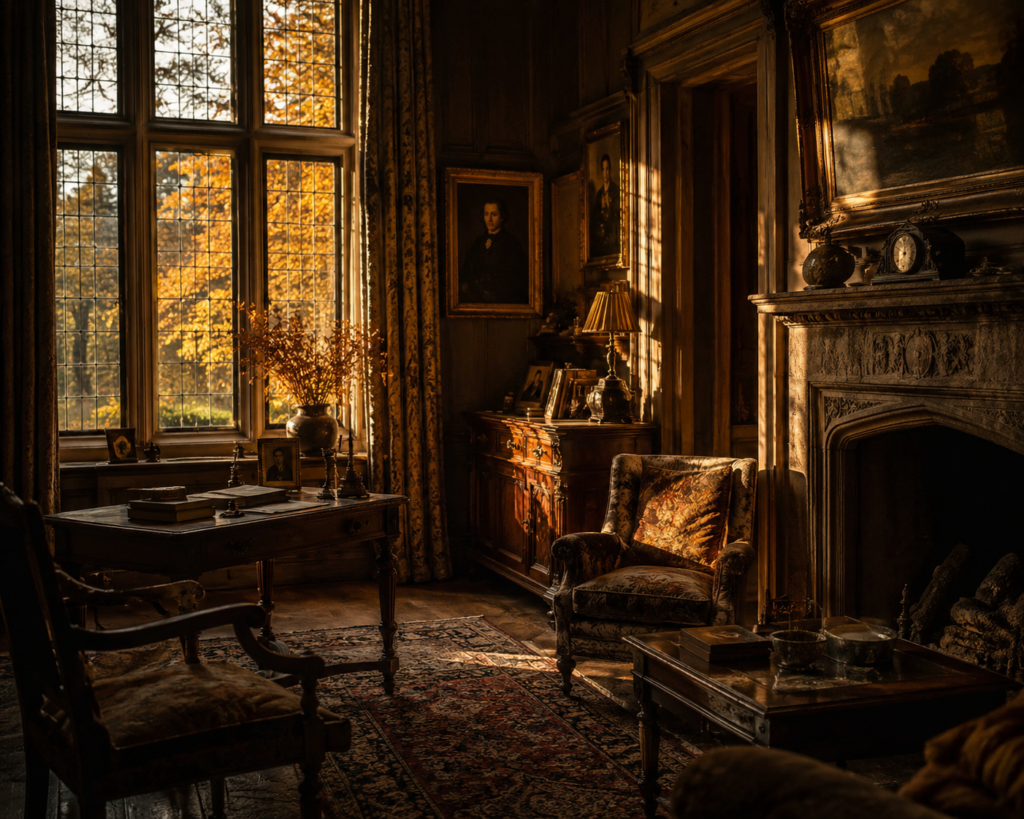
There is a particular quality to English light in the evening that I have never been able to fully describe. It comes sideways through old glass, turns everything amber, and makes even an ordinary room feel as though something important once happened there — as though the people who stood in it before you left something of themselves behind. I was eight years old when I first noticed it, standing in a window of a house that had far too many rooms for one family. I have been chasing that feeling ever since.
My parents rented the main house on a working pig farm in Oxfordshire. The year was 1965. England in those years had a way of offering you exactly two choices when it came to housing: a cottage so small you had to breathe in to pass through the hall, or something grand and echoing that no single family could properly fill. We ended up in the latter — a house with thirteen rooms, most of them cold, all of them full of the kind of quiet that gets into your bones.
I was somewhere between eight and ten during the years we lived there, old enough to explore but young enough to still believe that every locked door might conceal a genuine mystery. As it turns out, I was right about that last part. I just didn’t know yet that the mystery would take sixty years to find its way onto the page.
A Farm That Smelled Like England
The pig farm was not romantic in the way that word tends to be applied to the English countryside. It was working land — muddy lanes, low stone walls, the sound of animals in the early morning before anyone else was awake. The gentry who owned the land had rented it to an American GI’s family before us, so while we were a novelty, we were welcomed by the working families on the farm who were practical people living in the smaller cottages nearby.
I remember the smell of the countryside more than almost anything else. England in the mid-1960s smelled of coal fires and damp grass and something deeper underneath, something old. Oxfordshire was not the dramatic moors of the north — it was gentler than that. Rolling fields, hedgerows that had been growing for centuries, villages with names that sounded like they came from a poem. The landscape had been quietly human for so long that history had simply settled into it, the way a book settles into a well-used shelf.
Thirteen Rooms and One Ginger Cat
We had a cat named Ginger. This is not a remarkable thing to say about a household — cats tend to accumulate in large houses, and a ginger cat in rural England is hardly a novelty. But Ginger had the particular personality of an animal who understood that he lived somewhere worth taking seriously. He moved through the farmland and those thirteen rooms as though he owned them in some prior, more legitimate sense than we did. He had his rooms and we had ours, and occasionally he would permit us to share the same space, often at naptime.
The rooms themselves had histories I could sense but not read. Old houses in England carry their past differently than new ones — not as a burden but as a presence. A fireplace that had been lit ten thousand times. Floorboards worn smooth by two centuries of footsteps. Windows that had looked out on the same hedgerow through two world wars. I was too young to articulate any of this, but I felt it. Children who grow up inside history often absorb it before they can name it.
What England Was, Then
This was the England of the mid-1960s — which is to say, an England still living in the long shadow of the Second World War, but beginning to feel something new stirring. The radio played music that would later define a decade. The village shops were still the village shops, not yet displaced by supermarkets and motorways. People kept kitchen gardens. Milk came to the door in glass bottles, left on stone steps in the morning cold.
I was an American child, absorbing all of this from the outside and the inside simultaneously. The accent was not mine. The customs were not quite mine. But the history felt like everyone’s. You cannot stand in an English field blanketed with daffodils and not feel the new growth covering the weight of everything that happened in that ground. I did not know yet that this feeling would follow me into the work I would eventually do. But it was being laid down in me then, in those amber-lit rooms with their thirteen different stories, while Ginger conducted his independent surveys of the property.
The House That Became Brookhaven
When I began writing Death at Brookhaven, my new novel, out this July, I understood something I couldn’t have explained when I was eight. A house in a book is never just a setting. It is a character. It holds secrets. It shapes the people inside it, determines what they can and cannot see, controls who moves freely and who does not. An English country estate in the early days of Hollywood glamour carries all of that — the old world and the new world in uneasy, fascinating collision, much like the mid 1960s in England.
I know what it feels like to walk the hallways of a house like that. To sense that the rooms have witnessed things you are only beginning to guess at. To wonder, standing in a doorway, what happened here before you arrived.
Death at Brookhaven is a historical fiction, cozy mystery with clean romance, set where an English estate meets the dazzle and danger of early Hollywood. It is full of intrigue and atmosphere and the particular thrill of a world in which nothing is quite what it appears. But at its heart, it is a story about what happens inside a house and about the people who carry its secrets.
I think it began, without my knowing it, in an old manor farmhouse in Oxfordshire, with a ginger cat on the stairs and English light coming sideways through old glass.
Death at Brookhaven arrives in July 2026 — available for pre-order soon. If you love mystery, romance, and the feeling of stepping into a world that glitters on the surface and runs much deeper underneath, I hope you’ll join me there.