
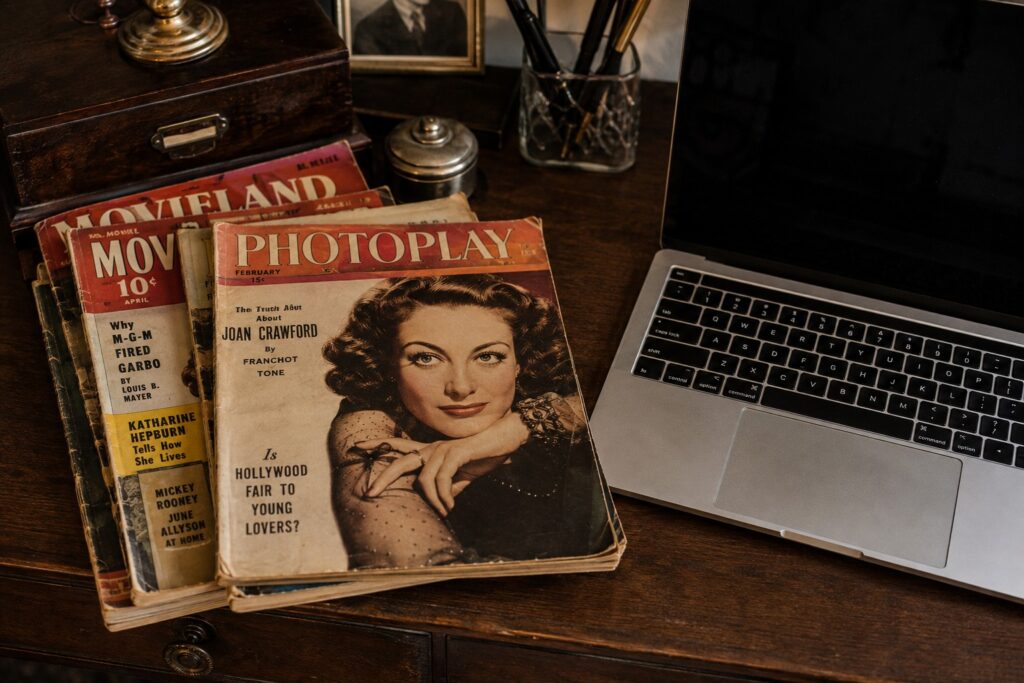
I’ve spent months this year with stacks of old biographies, fan magazine reprints, and transcribed interviews with stars who lived through the 1940s Hollywood studio system era. Somewhere in the third or fourth book, a pattern started to surface that no single account had told me on its own. The same phrases kept appearing in different voices, decades apart. “The studio owned me.” “I didn’t recognize the girl in the photographs.” “I stopped knowing where she ended and I began.” I sat with those lines longer than I meant to.
That’s how most of my research starts. Not with a grand theory about an era, but with a phrase that won’t let me go, echoed by enough different people that I know it’s true.
The Studio as a Small, Watchful Kingdom
By the 1940s, the major studios, MGM, Warner Bros., Paramount, 20th Century Fox, functioned less like production companies and more like self-contained towns. They had their own hospitals, schools for child performers, hairdressers, and dieticians, plus publicity departments that worked around the clock. Everyone under contract belonged to the studio in a way that’s hard to imagine now. Writers, directors, cinematographers, and stars alike were assigned to pictures, loaned to other studios, and shaped into a persona the front office believed audiences wanted.
The term for it, “the studio system,” sounds almost administrative. It wasn’t. It was a machine for manufacturing not just films, but people. That’s the part interviews with the stars themselves make plain in a way no textbook ever could.
The Gossip Column as a Weapon
I’ve read a great deal about the influence of Hedda Hopper and Louella Parsons, and what strikes me isn’t the glamour. It’s the leverage. Studios fed these columnists exclusives in exchange for cooperation, and a single item could end a career or launch one overnight. Actresses were paired publicly for “dates” that studio publicists arranged and controlled. Marriages were timed to premieres. Pregnancies were hidden, delayed, or written into press releases as something else entirely.
More than one star, in interviews given decades later, described reading about their own supposed romance in the morning paper before they’d heard a word of it themselves. What reads today as gossip was, at the time, a quiet form of governance. The public thought it was watching stars live their lives. It was watching a story the studio had already written.
The Ones History Left Out
The stars get remembered. The system that shaped them tends to fade into footnotes. But when I dig into this era, I find myself drawn to the people just outside the frame: the contract players who never became household names, the studio nurses who signed off on actresses too exhausted to work, the wardrobe assistants who knew every secret in the building and never told a soul. Their names rarely appear in the standard histories. Their fingerprints are all over the era anyway, if you know which books to open.
This is the pull that history has on me. Not the polished version, already turned into legend, but the version still waiting in the margins of someone’s memoir. There’s a story in every name in every studio roster. That’s what keeps me reading.
Who You Become When You’re Always Watched
The question that follows me out of this research isn’t really about Hollywood at all. It’s this: who are you when everyone around you is watching a version of you that isn’t quite true? Some of the stars I’ve read about described the split as unbearable, a private self they had to protect at all costs. Others described something stranger and sadder. Over years of interviews, premieres, and carefully staged photographs, they stopped being able to find the line at all. The public self simply became the self. Not by choice, but by wear.
I don’t think there’s one right answer to which fate is worse. Both feel true, depending on the person and the year of their life you catch them in. That uncertainty, I think, is the most human thing about the era. It’s also exactly the kind of tension I can’t resist as a novelist. When history hands you a world built on secrets and appearances, it’s practically begging for a mystery to be set inside it.
A Story Set in That World
That question, of who you are when the world is watching a version of you that isn’t quite you, and whether you can ever fully return from that, sits quietly inside my new novel, Death at Brookhaven, releasing September 7th. It’s a book that grew out of exactly this kind of research: old interviews, old columns, old lives lived under conditions most of us would find unbearable now. I can’t wait to share it with you.
If you’d like to be among the first to know when it’s available, and to hear the research and discoveries that shaped it along the way, I’d love for you to join the Readers’ Circle. It’s where I share the stories behind the stories, long before they make it into a finished book.