
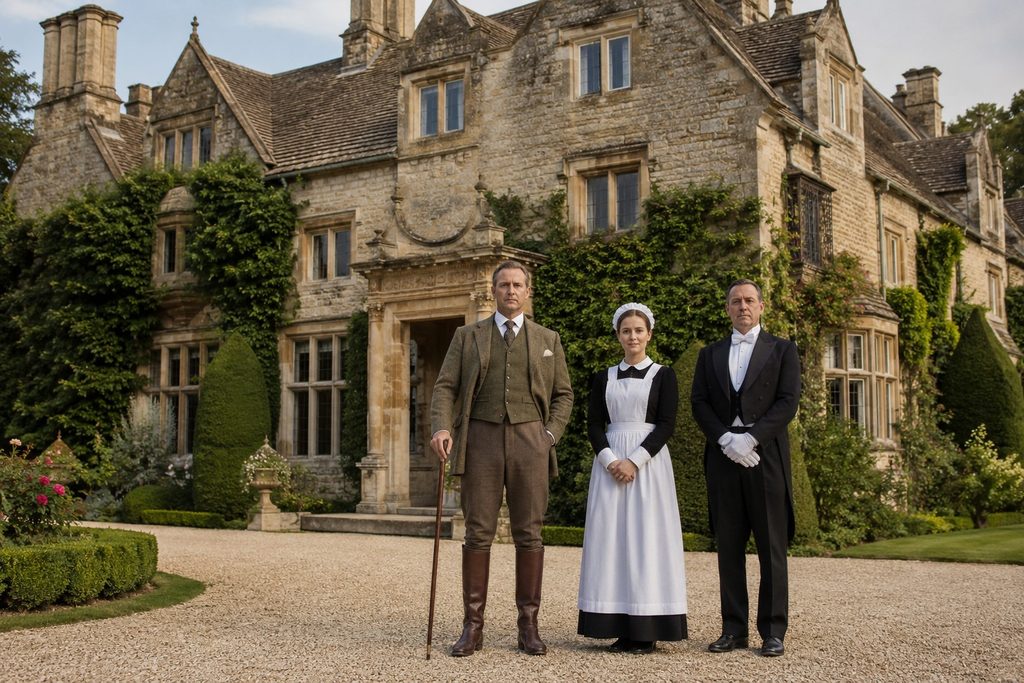
Walk into a great English country house in 1935 and the rules of the world are as fixed as the architecture. A butler answers to no one but the master. A housemaid does not speak unless spoken to. The family takes breakfast in the morning room; the servants take theirs an hour earlier in the kitchen. Everyone knows their place, and the house runs on that knowledge the way a clock runs on gears.
Walk into that same house thirty years later, and the gears have changed shape entirely — if the house still has staff at all.
The relationship between those who owned English manors and those who kept them running went through one of the most dramatic social transformations of the twentieth century in the space of a single generation. Understanding that shift means understanding not just what changed, but why the old order was so fragile to begin with.
The Pre-War Household: Order as Identity
Before the Second World War, a large staff was not simply a convenience — it was a statement of who you were. A country house with fewer than a dozen indoor servants was, by the standards of its class, barely keeping up appearances. The hierarchy below stairs mirrored the hierarchy above it with almost comic precision: the butler and housekeeper ruled their respective domains as the lord and lady ruled theirs, and a strict pecking order governed everyone from the first footman down to the youngest scullery maid.
What made this system endure wasn’t affection, though genuine loyalty certainly existed in many households. It was dependence, made mutual by scarcity. Domestic service was one of the largest employers of labor in Britain, particularly for women — a vast pool of young people, often from rural or working-class families, had few alternatives to entering service. The employer held enormous power: housing, wages, references, even permission to marry could all hinge on the master or mistress’s approval. In exchange, servants received security of a kind — a roof, meals, and a defined role in a world that offered few of them elsewhere.
The relationship was intimate in proximity and distant in status. A lady’s maid might know her mistress’s body and secrets more thoroughly than her husband did, yet address her only as “Madam” and never sit in her presence. Closeness without equality was the entire architecture of the system.
The War as Fracture Line
Two forces broke this arrangement, and both trace back to the war years.
First, the war emptied the servants’ hall. Young men went to fight; young women were conscripted into factories, land work, and the auxiliary services, where wages were higher, hours were regulated, and crucially, the work came with a sense of national purpose rather than private servitude. Many never returned to service once they’d tasted an alternative.
Second, and just as important, the war changed what people believed they were owed. A generation that had endured rationing, bombing, and mass mobilization together did not easily slip back into a world where some people ate in the dining room and others ate standing in the scullery. The war was, among many other things, a crash course in the idea that everyone’s contribution mattered equally to survival — and that idea did not stay confined to wartime.
The 1950s: Managing Decline
By the 1950s, the great houses that survived at all — and many did not, falling to demolition, requisition, or the National Trust — were operating with a fraction of their pre-war staff. Death duties, punishing income tax, and the sheer unaffordability of large domestic payrolls forced families into hard choices. Wings were closed off. Butlers gave way to a single “gentleman’s help.” Housekeepers took on duties that would once have been split among three separate roles.
This is where the relationship itself began to change shape, not just the numbers. When a household goes from fifteen staff to three, the remaining employees are no longer interchangeable cogs in a system — they are known individuals, relied upon personally, often for decades. The rigid hierarchy of pre-war service required scale to function; strip the scale away, and what’s left is something closer to a working partnership, however unequal it remained on paper.
The 1960s: Contract Replacing Custom
By the 1960s, the transformation was largely complete, at least among the households that endured. A few real, structural shifts defined the decade:
Employment law started to matter. National Insurance, minimum standards, and a labor market with genuine alternatives meant domestic service was now a job a person chose among options, not a life a person was born or funneled into. That single fact rebalanced the power in the relationship more than any change in manners could.
Staff increasingly lived out, not in. The daily cook, the woman who “did” for a family a few days a week, the part-time gardener — these arrangements replaced the live-in servant whose entire existence was structured around the household. Live-out staff kept their own homes, their own lives, and their own terms in a way live-in servants rarely could.
The old forms of address softened, even where the old respect remained. Many households moved from “Parker” or “Mrs. Hughes” toward first names, particularly with younger family members. This wasn’t always experienced as liberation by the staff themselves — plenty of older servants found the informality presumptuous rather than kind, a loss of a dignity that formal titles had actually conferred. The shift toward casualness didn’t map neatly onto a shift toward genuine equality; it sometimes just meant the old courtesies were abandoned without anything of equal weight replacing them.
And perhaps most tellingly, the emotional register changed. Pre-war relationships were built on paternalism — the employer as benevolent (or not) authority, responsible for staff in the way a parent is responsible for a child, with all the control that implies. By the 1960s, especially in households where a small remaining staff had weathered decades together, something closer to genuine mutual reliance had emerged. The employer needed the housekeeper’s competence to keep the house afloat at all; the housekeeper’s status and reputation were now visibly tied to the family’s survival too. It was less lord-and-servant and more, in the households that handled the transition well, two people managing a difficult situation together.
What Didn’t Change
It’s worth resisting the temptation to overstate the transformation. Class remained class. Even the friendliest 1960s employer rarely imagined the cook joining them for dinner, and the deference required of staff, however diminished, didn’t disappear. What changed was less the fact of hierarchy than its terms: hierarchy by choice and contract rather than hierarchy by near-total dependence and lifelong expectation.
The great houses that survived into the 1960s did so, in large part, precisely because they learned to run on this new footing of smaller staffs, real wages, genuine (if limited) autonomy for employees, and relationships that had to be maintained rather than simply assumed. The ones that couldn’t make that adjustment are, for the most part, the ones that are gone.
See such a relationship between employer and staff in my new book Death at Brookhaven, coming September 7th.