
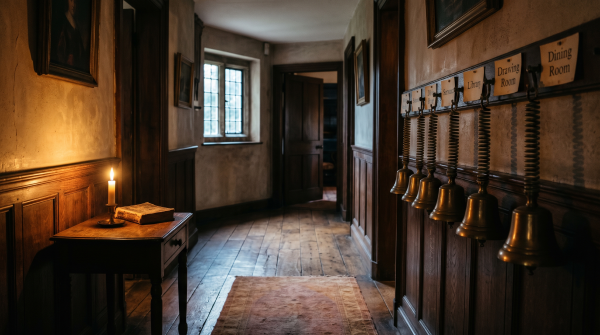
It is the hour when the house finally goes quiet, and then a floorboard speaks. Not a bang. A slow, deliberate creak, as if someone has stepped onto the landing and stopped to listen.
If you have ever lain awake in an old house and wondered why old English houses creak at night, you are in good company. The sound has worried readers and writers for centuries. The explanation is both simpler and more interesting than a ghost.
The house is cooling, and it is moving
The everyday answer is thermal expansion. During the day the sun and the heating warm the timber, plaster, metal pipes and roof beams. At night everything cools and contracts, and materials that shrink at different rates slide against each other. Each small creak is stress being released.
Winter makes it worse. Cold air dries the timber, and the outside of a house shrinks while the foundations, held in the ground, stay put. Many old houses are noisier from November to March for exactly this reason.
Wood never stops breathing
Old timber is hygroscopic, which is a grand word for a simple habit: it takes up moisture from the air and gives it back again. A damp week swells a floorboard or a beam. A dry week shrinks it, and tiny gaps open that joints can shift into.
An old English house may hold centuries of oak, elm and pine, each piece answering to the weather in its own way. Stairs, floors, panelling and roof timbers all join in. Nothing is wrong. The house is simply adjusting.
The quieter the night, the louder the house
Part of the effect is in our ears. When the day’s noise stops, a sound that was there all along suddenly has the whole night to itself. Heightened awareness, the kind we feel alone in the dark, can also make an ordinary sound feel like a message.
Even modern houses that are well sealed and insulated can seem to talk more, for the same reason: with less background noise, you hear every small settling. An old house adds centuries of joints, beams and boards to that quiet, so it has far more to say.
The sounds that once meant something
In the great houses, a night was never silent for the people who worked there. From the eighteenth century, as English country houses grew, the servants were moved into separate wings and out of sight. A system of bells grew up to call them. Major rooms had bell pulls or levers, connected by long runs of wire to bells in the servants’ quarters.
In some houses, a wooden board hung with brass bells in the servants’ hall was labelled by room: the Drawing Room, the Front Hall, the White Room. The bells hung from coiled springs and kept swinging after they rang, so a servant could see which room had called. They also had different sizes and tones, so a servant could tell by ear which bell had sounded. The famous green baize door appeared in the same period, to soften the noise of the kitchen and scullery on the other side.
So a house at night could hold a whole vocabulary: wires humming in the walls, a bell on its spring, footsteps on the back stairs. By the middle of the twentieth century, many of these houses had far fewer people to hear and answer those sounds. The wires and bells stayed behind in the walls.
Why a creak makes such a good clue
This is what draws me to old houses as a storyteller. A creak is the perfect cozy mystery sound because it can be nothing at all, or it can be someone who should not be there. The reader is never sure which, and that small uncertainty carries the whole scene.
That in-between feeling is the atmosphere I love most in a story set in 1960 Oxfordshire, where Death at Brookhaven takes place: a house full of history, where every sound might simply be the timber settling, or might be something more.
When a creak is only a creak
For anyone lying awake in a real old house tonight: creaking at dusk and in the small hours is almost always harmless. If you notice cracks that keep widening, doors and windows that suddenly stick, or sounds that change rather than repeat, it is worth asking a surveyor to take a look.
Most nights, though, your house is only keeping its own old time. Listen to it for a moment. It has been settling for a very long time, and it has seen a great deal.
If you love the history behind the stories as much as I do, I would be glad to have you in my Readers Circle. You will receive a free illustrated guide to 1960s England and the first two chapters of Death at Brookhaven: Readers’ Circle