
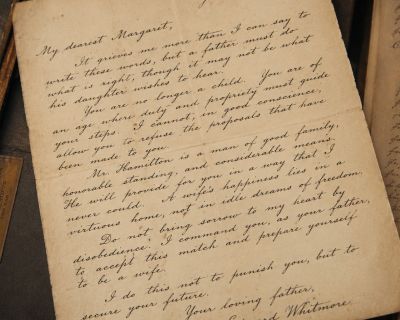
There is a particular kind of letter that turns up again and again in historical archives, and it never fails to stop and show me what history teaches us. Someone, usually young, writing to a parent or a guardian, trying to explain a choice that no one around them understands. A different trade. A different marriage, or none at all. A different country. The letters vary in period and place, but the shape of the argument is always the same: I know what you want for me. I have to tell you what I want for myself.
The Weight of Other People’s Certainty
Every era has its version of the sensible path, and every era has people whose job it seems to be to point you toward it. Family expectation. Social convention. The simple economics of survival, which for most of history left little room for anything but the practical choice. Historians sometimes write about this as though it were purely structural, a matter of class and circumstance. But read enough personal letters and diaries and you start to see something else underneath the structure: individual people, quietly aware that the life laid out for them was not the life pulling at them.
What history teaches me, researching period after period, is how confident the people giving advice always sound. A guardian certain that a trade apprenticeship is the only sensible future. A mother certain that a particular marriage is the only safe one. Their certainty is rarely malicious. It is usually love, filtered through fear, dressed up as wisdom. And it is very often wrong, not because those people didn’t care, but because caring about someone and knowing what they are meant to do with their life are two entirely different things.
The Ones the Archives Remember
Here is the pattern history teaches that keeps drawing me back to this work: the people whose stories survive, whose names get kept in family papers and parish records and the footnotes of larger histories, are disproportionately the ones who did not take the expected road. Not because rebellion made them interesting. Because listening to something quieter than expectation, and acting on it, tends to produce a life with enough shape and consequence to be worth writing down.
This shows up everywhere once you start looking for it. In apprenticeship records where a young person is listed under a trade their family clearly did not choose for them. In correspondence where a woman explains, carefully and at length, why she has decided against the arrangement everyone assumed she would accept. In the sparse, maddening gaps in the historical record where we can tell someone left the path they were handed, even when we can’t fully reconstruct why. Over and over, the thread pulling people off the expected road turns out to be the thread worth following into a story.
Why Fiction Keeps Returning to This Question
This is part of why historical fiction exists as a genre at all, I think. Straight history teaches you what people did. It has a harder time reaching what it felt like to stand at that fork in the road, unsure, with people you love telling you exactly which direction was safe. Fiction can go there. It can sit inside the uncertainty, the guilt of disappointing someone, the strange clarity that arrives when a person finally stops asking others what they should want and starts noticing what they already want.
My characters like Carrie Mitchell in Call of the Blackbird live in that fork constantly. Not because it makes for convenient plotting, though it does, but because it is one of the truest patterns I’ve found in what history teaches us. The people who felt most alive, then and now, were rarely the ones who simply complied.
What the Past Is Trying to Tell the Present
I don’t think this pattern belongs only to history. If anything, the record makes the present case more clearly: the people around you can love you completely and still be wrong about what your life is for. Their certainty is not evidence. It is simply their fear, wearing the costume of good advice.
Self-discovery, as far as I can tell from decades of other people’s letters, has never been loud or dramatic. It looks like small, repeated moments of noticing what actually pulls at you, and choosing to trust that over the version of your life other people find easier to explain at dinner. History does not remember the people who took the safe road because it was safe. It remembers the ones who paid attention to the pull, and had the nerve to follow it.
If this is the kind of question you find yourself circling, I’d love to have you along as I keep exploring it, in research and in Death at Brookhaven. The Readers’ Circle is a small, informal group of readers who hear things first: early chapters, cover news, and behind-the-scenes research notes like this one. It costs nothing. It simply means you love this kind of story and want to be part of it from the beginning.
You can join here: Readers’ Circle