
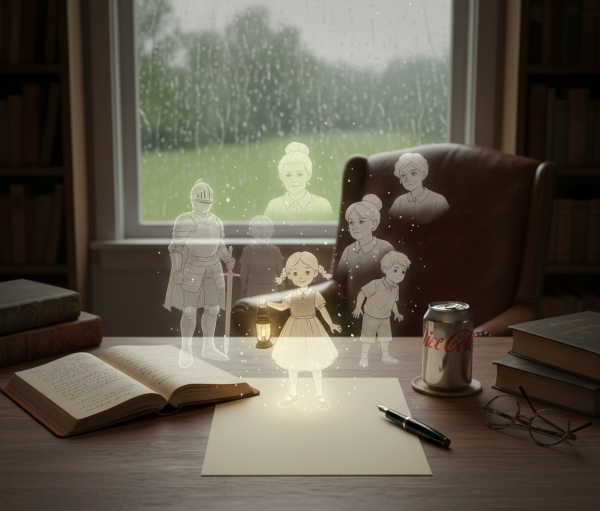
There is a particular kind of silence that settles over you when a book is finished.
Not the satisfied silence of a good night’s sleep, or the quiet that follows a long conversation with an old friend. It’s something more complicated than that — a stillness that holds, somewhere inside it, the faint echo of voices you’ve been listening to for years. The voices of people you created, and came to love, and then had to let go.
I know what it is to miss a character.
They Become Real While You’re Writing
When I was deep in the writing of Call of the Blackbird, my characters were as present to me as anyone I’ve ever known. I thought about them in the morning before I sat down to write. I wondered about them at night. I found myself having conversations with them — one-sided, perhaps, but conversations nonetheless — working out what they would do next, what they feared, what they hoped for, what they would never say aloud.
That is the particular intimacy of writing historical fiction. You are not just inventing people. You are placing them inside real history, inside real events that carried real consequences, and asking yourself: what would it have felt like to be here, in this moment, carrying this particular life?
You have to know them that well. You have to feel what they feel. And somewhere along the way, without quite meaning to, you let them in.
The Grief Nobody Warns You About
When the last word is written and the book is sent into the world, there is a quiet grief that I don’t think is talked about enough.
The story continues on the page, but the process of living with these characters — the daily act of returning to them, sitting with them, puzzling them out — that comes to an end. There are mornings when I still reach for them out of habit, the way you might reach for your phone to call a friend before remembering they’ve moved far away.
They were so present for so long. And now, in the strange aftermath of a finished book, they feel just out of reach.
I’ve heard other writers speak about this, and I’ve read enough about the creative life to know I’m not alone in it. But knowing you’re not alone doesn’t quite fill the space they leave behind.
History Makes It Different
With historical fiction, the longing runs even deeper — because the characters, though fictional, are woven from real history, real places, real people who once walked the earth. When I step away from the manuscript, I’m stepping away not just from invented names but from an entire world I have spent years researching, inhabiting, trying to understand.
The grief is layered. There is missing the characters themselves. And then there is missing the world they lived in — the rooms, the light, the language of another era that I had made my own for a little while.
Some days I miss it the way you miss a place you traveled to once and always meant to return to.
But Here Is the Beautiful Thing
Here is what I remind myself on those days: they are still there.
They are there on the page, exactly as I left them, waiting with the same patience they always had while I was searching for the right words. The story hasn’t gone anywhere. The world I built for them hasn’t disappeared. It’s simply resting between covers, waiting for someone to open it.
Some mornings I pick up Call of the Blackbird and read a passage — just a few pages, the way you might glance through a photo album — and there they are. Exactly as I remember them. Every word I worked and reworked to get right, now carrying them forward as I always hoped it would.
It’s a reunion of the quiet kind.
And Then There Is the Audiobook
There is something I didn’t expect when Call of the Blackbird became an audiobook: a second reunion I hadn’t anticipated.
To hear those characters given voice — to have someone else carry them through sound, through intonation, through the particular music of spoken language — is to meet them again in an entirely new way. I have sat and listened and found myself surprised, moved, even delighted, as though I were encountering them for the first time in a different light.
On the days I miss them most, I turn on the audiobook and I say hello.
It sounds a little like madness, I know. But I think any reader who has ever loved a character — truly loved one, the way you love a person — will understand exactly what I mean.
An Invitation
If you have never met the people inside Call of the Blackbird, I would love for you to.
They are the reason I kept writing when the history was difficult and the words were slow. They are the reason I cared so much about getting it right. And they are the reason I know, with certainty, that the longing I feel when the book is done is worth every single page.
Pick up the book. Read it, listen to it, carry it with you.
And if you fall for them the way I did — I promise, they’ll always be there when you want to say hello.
Call of the Blackbird is available in paperback, Kindle, and audiobook.