
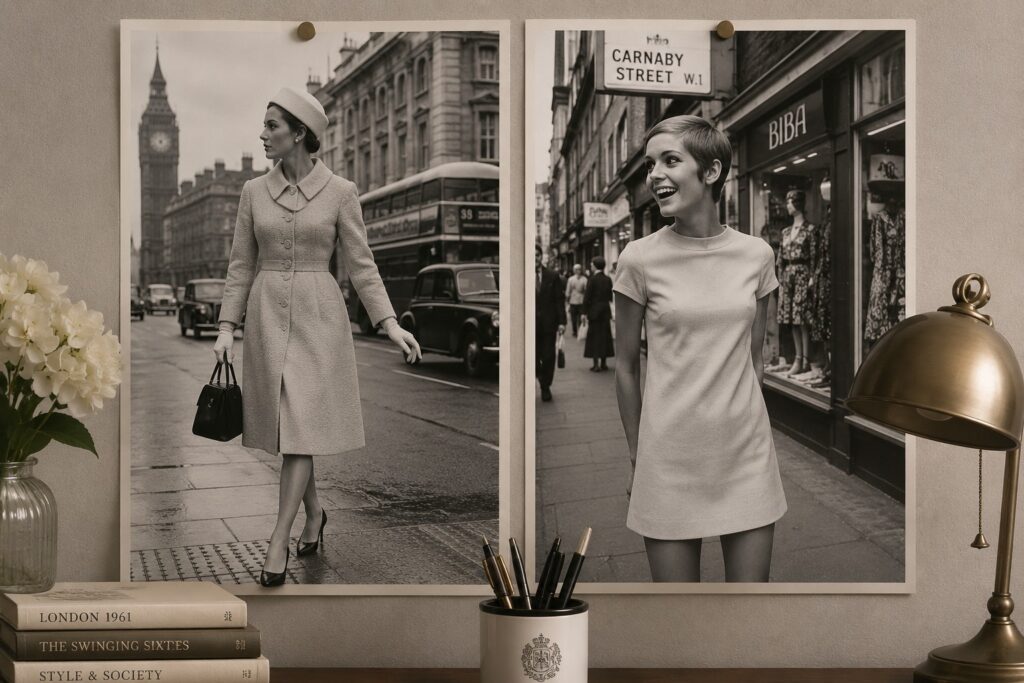
I have two photographs pinned above my desk right now that epitomize England’s 1960s fashion. In the first, a woman crosses a London street in 1961 wearing white gloves, a pillbox hat, and a coat nipped so precisely at the waist it looks tailored to her breath. In the second, taken barely five years later on Carnaby Street, a girl with cropped hair and enormous eyes wears a dress that stops well above the knee, and she is laughing at something just outside the frame. Same city. Same decade, even. Two entirely different women.
Just above those photographs sits a shelf that gives away one of my worse-kept secrets. I collect etiquette books, the older and more forgotten the better. Not for the rules themselves, most of which I have no intention of following, but because an etiquette book is one of the most honest documents a culture ever produces. Nobody bothers writing down what is expected of a woman in a given year unless someone still needs reminding of it, which means the reminder itself becomes a kind of confession.
I have been staring at those photographs, and pulling books off that shelf, for weeks while researching Brookhaven, my next novel, which opens in Oxfordshire in 1960, right at the hinge point between those two women. I keep asking myself the question that started this whole search: how did a country so devoted to decorum become, in under ten years, the place the rest of the world looked to for permission to break the rules?
The World Before the Break
To understand what happened in England in the 1960s, you have to understand what came before it, because the revolution only makes sense as a reaction.
At the start of the decade, the reigning silhouette belonged to women like Grace Kelly, whose transformation from actress to Princess of Monaco had made her the global shorthand for composed, ladylike grace. Jacqueline Kennedy, newly installed as First Lady in Washington, wore Oleg Cassini’s clean, structured suits and pillbox hats with a precision that made restraint itself look aspirational. And Audrey Hepburn, in her Givenchy gowns and cigarette trousers, gave millions of women a template for elegance that was disciplined, deliberate, and just slightly untouchable.
These were not English women, but their influence sat over England like weather. England’s 1960s fashion still answered to a certain generation’s idea of what a woman should look like: composed, covered, and dressed for someone else’s approval.
Then a shopkeeper on the King’s Road decided the rules no longer applied to her.
Mary Quant and the Street That Started It
Mary Quant opened her boutique, Bazaar, on the King’s Road in Chelsea in 1955, and for the first years of its life it was a curiosity more than a movement. But by the early 1960s, Quant had begun hiking her hemlines higher than any established designer would dare, and she was doing it for a very specific customer: young, working, and no longer interested in dressing like her mother.
That is the detail that stops me every time I return to this research. The miniskirt was not really about fabric. It was about who got to decide what a young woman wore, and for the first time in living memory, the answer was the young woman herself.
Carnaby Street became the physical proof of the idea. What had been a quiet Soho backstreet filled almost overnight with boutiques selling clothes that were bold, cheap enough for a shopgirl’s wages, and utterly indifferent to what Paris said was correct. London stopped looking upward to older, more established fashion capitals and started looking at its own teenagers instead.
Twiggy and the Face That Changed Everything
By 1966, the revolution had a face, and it belonged to a seventeen-year-old from Neasden named Lesley Hornby, known to the world as Twiggy. Impossibly thin, cropped hair, lashes painted on in careful rows, she was declared “The Face of 1966” almost the moment she appeared, and she became the walking argument for everything Quant and the King’s Road boutiques had been building toward.
Vogue’s Diana Vreeland had already coined a word for what was happening: youthquake. It captures exactly what made this different from every fashion shift before it. This was not a new hemline trickling down from the aristocracy. It was a tremor that started with ordinary teenagers and shook everyone else, aristocracy included, into following.
Barbara Hulanicki’s boutique Biba, which had grown from a mail-order dress in 1963 into a Kensington shop by 1964, became Twiggy’s own favorite haunt, proof that the girls making the clothes and the girls wearing them were now, for the first time, the same age and the same social world.
What the Etiquette Books Confess
Two of the books on that shelf bracket exactly the years I have been researching. The earlier one, printed in Britain at the start of the decade, spends whole chapters on the correct glove for a daytime call, the proper way to address a peer of the realm, and the choreography expected of a girl being introduced into society. It assumes its reader will be chaperoned, corrected, and, above all, watched.
The later one, printed only a handful of years after, has quietly let most of that go. The chapter on presentation at court is gone, fittingly, since the ceremony itself had ended in 1958. What replaces it reads less like instruction and more like reassurance, as though the author senses her readers are no longer asking permission so much as looking for company.
I find that more revealing than either photograph. A hemline tells you what changed. An etiquette book tells you what someone in authority was still trying to hold on to, and roughly when they gave up trying.
What the Revolution Was Really About
I do not think England’s 1960s fashion revolution was ultimately about clothes, or even the rule books trying to keep pace with it. It was about who gets to author their own image. For most of history, that authorship belonged to someone else: a husband, a court, a class system, a well-thumbed book of manners ready to enforce it. Grace Kelly, Jacqueline Kennedy, and Audrey Hepburn were extraordinary within that system, but they were still, in a real sense, dressing inside it.
Twiggy and Mary Quant dressed outside it, and an entire generation of English women followed them out the door.
That is the thread I keep pulling as I write Brookhaven. A story set in 1960 sits right at that hinge, in a country that has not yet decided which version of itself it is going to become. I find I cannot write a character from this period without asking what she is wearing and, more importantly, without asking who chose it.
If you love the moment when history stops being a textbook fact and starts feeling like something you could have lived through, I would love to have you along as I Death at Brookhaven launches this September. Join the Readers’ Circle and get announcements first, and insights others don’t see. Join the Readers’ Circle
With love for the past,
Nancy