
The knock came hard enough that my mother set down her tea.
It was the neighbor’s boy on the step, red in the face and out of breath, and nothing was wrong — nobody was hurt, nothing was on fire. He needed coins. The match was on, the television had gone dark with the score level and minutes left to play, and there wasn’t a shilling left in the house.
We found him his coins. He ran back down the lane holding them in his fist like a relay baton.
I think about that boy every time someone asks me what life in 1960s England was actually like. Because the answer isn’t in the newsreels. It isn’t the Beatles or the World Cup or the Prime Minister. It’s a child sprinting across a wet lane with a fistful of change, because that was what watching the end of a football match cost you.
The walls were never really clean
Everything was coal.
Coal heated the rooms, one fireplace at a time. Coal fed the Aga in the kitchen. Coal arrived by delivery and went into a shed behind the garage, and from there it was carried in scuttles, room to room, hearth to hearth, all winter long.
And coal leaves. It settles into wallpaper and curtains and the wool of a coat. Above every fireplace the wall went gradually darker in a soft grey bloom, and no amount of scrubbing ever quite took it back. You could wash a wall and see the water in the bucket turn the color of weak coffee, and you could wash it again the next month and get the same bucket.
The smell got into your hair. It got into everything. Even now, decades on, a coal fire smells to me like a particular kind of cold.
Television came with a meter
Sets were often rented rather than bought, and a good many of them came with a coin box bolted to the side or sitting on top like a small, unblinking tax collector. You fed it, and it gave you time. When your time ran out, the picture ran out with it.
Which meant television in our corner of England was never really relaxing. There was always an arithmetic running underneath it — how much is in the box, how long is left in the program, is it worth going for your coat and finding more.
And every so often, the arithmetic failed you in the ninety-first minute, and you sent your son running to the neighbors.
The world came to the door
We did not drive to shops. The shops came to us.
The milkman came daily, well before anyone sensible was up, and left bottles on the step with the cream risen thick at the neck. In cold weather it pushed the foil caps up like little chimneys. In any weather, the birds got at them if you were slow.
The grocer came weekly and took the order standing in the doorway with a stub of pencil, and if you’d forgotten something, you did without it until the following week. That was simply the shape of things. You planned, or you learned to.
It sounds inconvenient written down. It wasn’t, particularly. It was a rhythm. You knew the men who came to your door and they knew your house, and there was a kind of steadiness in that which I have never entirely found again.
The pantry did what the refrigerator couldn’t
Our refrigerator was small — smaller than most Americans would believe, closer to a cupboard than an appliance. It held very little, and it was never the point.
The point was the pantry. A cold room, north-facing, thick-walled, with a slab of stone or slate for a shelf that stayed cool through anything but the worst of August. Milk, butter, meat, and the pudding for Sunday all lived out there, and they kept perfectly well because the house itself did the work.
That is the thing about an English house of that period. It wasn’t fighting the weather. It was built to cooperate with it.
You dressed for indoors
There was no such thing as a warm house. There was a warm room.
Whichever fireplace was lit, that was where everyone went, and the rest of the house stayed at whatever temperature England had decided on that morning. Hallways were something you crossed at speed. Bedrooms were cold enough that you got dressed under the blankets first and made a run for it. Everyone owned more layers than furniture.
The Aga was the one constant — a coal-burning monster that heated the kitchen, cooked the food, and produced the hot water, whether or not it felt cooperative on any given day. My mother fought that stove for a year and I am not certain she ever won a single round. But it kept us in hot baths through an English winter, and for that we forgave it a great deal.
(Her account of that particular war is worth reading on its own — see “The Aga and I: A 1960s Perspective.“)
And then, the daffodils
I have made all of this sound like an endurance test. It wasn’t.
Because you would come out of that cold, dark, soot-smelling house on a March morning and walk. Everyone walked. There were footpaths that had been footpaths for six hundred years, running along hedgerows and over stiles and straight across the edge of somebody’s field, and you were entitled to every one of them.
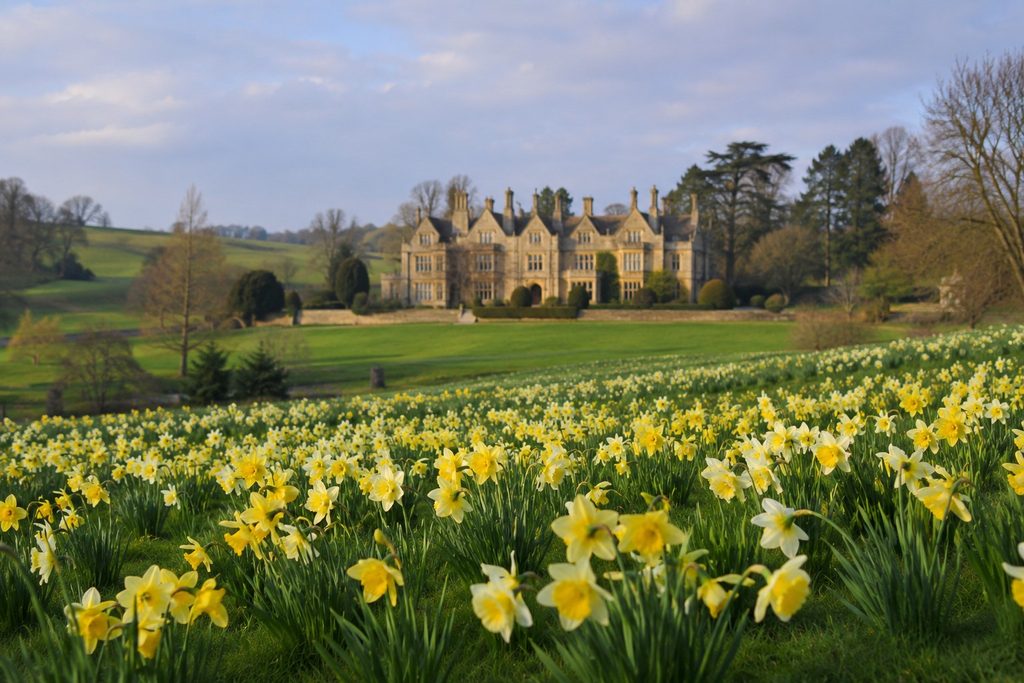
And in early spring, the daffodils came. Not planted in beds. Not arranged. Wild, in drifts, spilling down the banks and under the trees and out across the open fields in a yellow you could see from a long way off.
I have never seen anything like it since. That is what I remember most clearly of all of it — not the cold, not the coal dust, but standing at the edge of a field full of wild daffodils in a country that was not mine, understanding for the first time that a place can get inside you.
Why the small things are the true things
When I sat down to write Death at Brookhaven, set in England in 1960, I could have researched the era from books. Plenty of writers do, and do it well.
But I didn’t have to. I knew what the walls looked like above the fireplace. I knew the sound of bottles on a step at five in the morning, and the particular panic of a coin box running out at the wrong moment, and how the cold pantry smelled in summer.
History doesn’t live in the headlines. It lives in what a family did on an ordinary Tuesday — what they ate, what they burned, who knocked at the door and why. Get those right and a reader doesn’t feel like a tourist in the past. They feel like they’ve come home to it.
That’s the England I put into Brookhaven. Cold halls, warm kitchen, secrets in both.
Death at Brookhaven is available for preorder now — if you’d like to spend some time in a 1960s English country house, the door is open.