
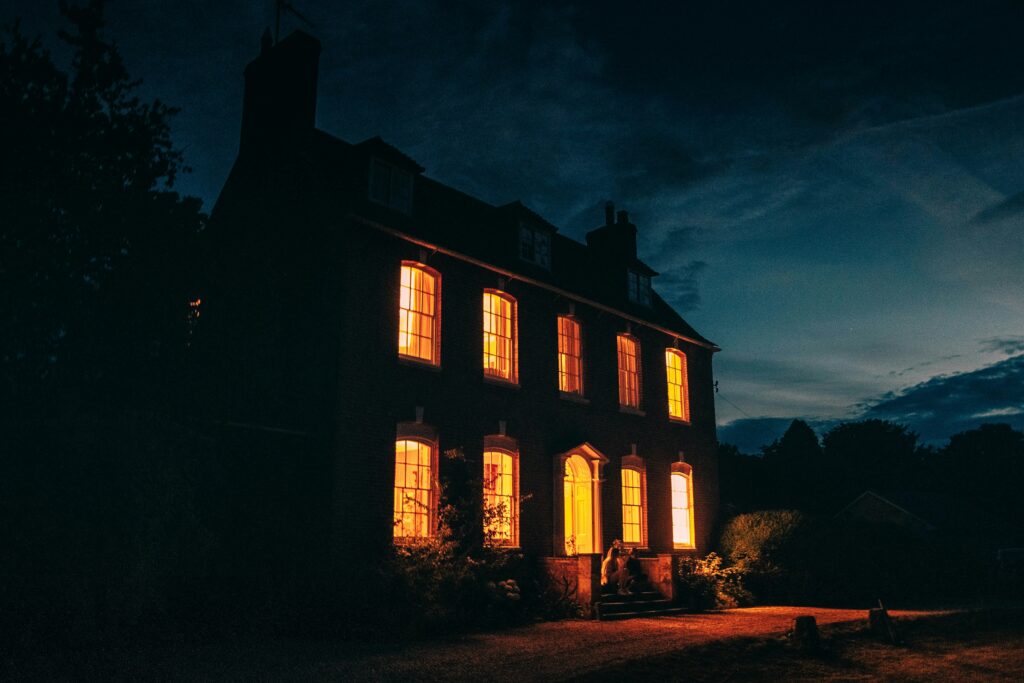
One of the strange things about October is someone asks me whether I believe in ghosts. I never quite know how to answer. What I do believe in is the strange moment, the one you can’t explain and can’t forget, the one that felt every bit as real as the coffee cup in your hand.
I’ve had one of those. Years ago I was lost on the back roads of East Texas. Dusk was coming on, and this was long before any of us carried a cell phone. Then I remembered a friend’s directions: “Turn right at Parker’s Store.”
And there it was.
What happened after that, I’m going to keep to myself for a few more days. Some stories are better told out loud with the light going, and I’m saving this one for Halloween. But that evening taught me something I think about every time I sit down to write a mystery, and that part I can tell you now.
Strange Things Arrive in Ordinary Clothes
Here is what I remember most clearly, all these years later. Not a chill. Not a sense of dread. Geraniums.
Geraniums in coffee cans, lined up along a porch railing. A red Coca-Cola chest by the door. Green paint with beige trim. There was nothing eerie about it. It was the kind of country store you could find on a hundred back roads, as plain and welcoming as somebody’s grandmother’s front porch.
I’ve come to think that is how strange experiences work. They rarely announce themselves with thunder and creaking doors. They arrive in ordinary clothes. The scent of a perfume in an empty room. A clock that stops at the same hour. A song on the radio at exactly the wrong moment. We believe them because they are ordinary in all the right places, and that is exactly why they stay with us.
Mystery works the same way. A reader will follow you almost anywhere, into a locked library, down a dark staircase, toward a truth no one has spoken aloud in ten years, if the teacups are right. If the coal fire smells the way a coal fire really smells. If the housekeeper folds her hands the way housekeepers did in 1960. The small, true details are what let a reader believe the extraordinary.
The Moment the Ground Shifts
Every strange story has a turn. A moment when what you know and what you’ve just seen refuse to line up. Mine came the next morning, and I have never quite gotten over it.
That gap is where mystery lives.
Every good mystery opens one. Something happened that shouldn’t have, and the story everyone has been told doesn’t quite fit the facts in front of us. The reader feels that mismatch the way you feel a draft from a window you were sure you closed. And then they lean in, because human beings cannot leave a gap alone. We have to know.
When I’m writing, I try to keep that gap open as long as I honestly can. Not with tricks, but with questions. Who is lying? Who is simply afraid? Who knows more than they are saying, and why have they kept quiet so long?
Some Houses Hold On to the Past
Old English houses have a way of holding on to their years. I know, because I spent part of my childhood in one.
In 1966 my family moved into a honey-colored stone manor house on a working pig farm outside Oxford. The oldest part was more than two hundred years old, with flagstone floors, and we used it as our dining room. There was a half-underground still room that kept food cold before anyone had a refrigerator, and a great oak front door with a second door behind it to keep out the drafts. It was cold most of the time. Nobody needed to tell you a story about a house like that. The house told you, simply by having stood there so long.
That is the feeling I wanted for Brookhaven. When Lydia Abbott returns to her aunt’s English estate in 1960, she finds a house full of whispered rumors, devoted servants who know more than they say, and a silence that has held for ten years, ever since her father was murdered there. It is haunted the way real houses are haunted, by what no one will speak about.
Even Writing Has Its Strange Moments
Here is a confession. Writing mystery has given me a few uncanny moments of its own.
Death at Brookhaven didn’t begin with a plot. It began with Mrs. Hendricks, the housekeeper who has served at Brookhaven for decades and has known Lydia since the day she was born. I didn’t build her piece by piece. I could just see her in my head, as clearly as I still see those geraniums.
And when I started writing, I didn’t know who the killer was. I thought I did. Then another character stepped forward, quietly, and suddenly everything fell into place. When I went back through the pages, it was as if the clues had been waiting there all along.
I can’t fully explain that either. Perhaps it’s simply how imagination works. Or perhaps stories, like old houses, know things before we do.
Why We Love to Be a Little Unsettled
I think this is why October suits mystery readers so well. The evenings draw in early. The wind picks up. We pull a blanket over our knees, turn on one lamp, and go looking for a story that will make the back of our necks prickle, just a little.
We don’t really want to be frightened. We want that delicious moment when the ordinary world tilts, and then we want someone to set it right again by the last page. A good mystery gives you both.
As for Parker’s Store, come find me on Halloween. I’ll be telling the whole story at dusk on my YouTube channel. Bring your blanket.
And in the meantime, I’d love to hear from you. Have you ever seen something you couldn’t explain? A place that seemed to remember? Tell me about it in the comments. I’m listening.
If you’d like to spend a few autumn evenings in a house where the past refuses to stay quiet, Brookhaven is waiting for you.
Step inside Death at Brookhaven at nancypolkhall.com/death-at-brookhaven, and join my Readers Circle for the free Historical Guide to 1960 England.