
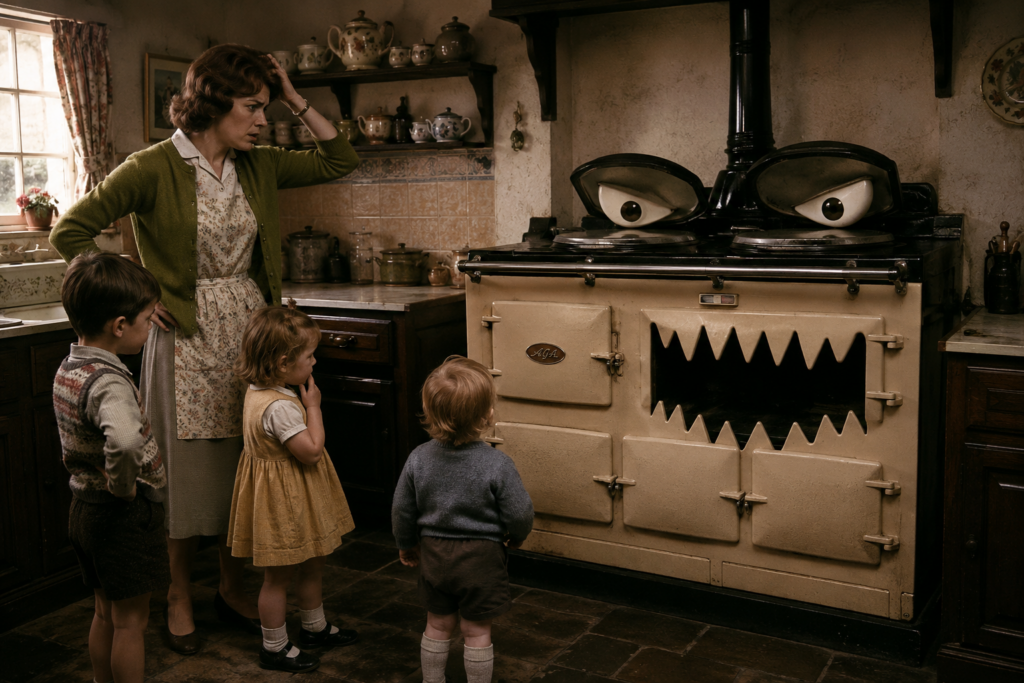
My mother is a woman who can handle almost anything with grace and good humor. England in the mid-1960s tested that theory considerably. To me, as a child, it was all adventure — rolling Oxfordshire hills, fields of wild daffodils, a barn on our property the locals proudly called “the new barn,” which had been standing for two hundred years. What I wasn’t privy to, at least not at the time, was the daily drama unfolding in our kitchen. Today Americans know the Aga as a gleaming showroom treasure, the crown jewel of the country kitchen. Ours was not that Aga. What follows is my mother’s account — and I’ll let her tell it.
-Nancy Polk Hall
Meet the Dragon
Have you ever wondered why English cooks are famous for their roast beef and Yorkshire pudding, but not for their smothered steak or apple pie? Why are English fruit cakes delicious and English layer cakes disasters? Blame it on the Aga cooker! I was told that English countrywomen swear by the Aga. But even after a year of using one, I still swore at it. The Aga is a monster in size, in operation, and in temperament. It is a huge, cunning, crafty, fire-breathing dragon lying in wait to massacre a good old homecooked American meal.
The estate agent’s tour of the thirteen room English country house which my husband had already rented ended in the kitchen. There in the corner crouched the biggest kitchen range I had ever seen. It was more than double the size of the largest American range, had four doors in front, and two large domes on top. I later learned the purpose of both doors and domes. It seemed to purr for Mrs. Grant, but for me it only hissed and snarled. Mrs. Grant said that she knew it was not quite what I was used to. She had seen American television shows on the BBC and imagined that all American housewives had kitchens like those of Mary Tyler Moore, Jane Wyatt, and Florence Henderson. Mrs. Grant gave me some rather hurried instructions about tending the Aga, shoved a “Your Aga Cooker” pamphlet into my hand, and “cherrio-ed” her way out the back door. Fortunately, we had dinner at a restaurant that evening.
The Daily Battle
The next morning at dawn I entered the kitchen prepared to perform the first rites in the care and feeding of the Aga. Clutching the pamphlet in my hand, I thought that if I serviced the Aga properly, maybe it would like me. I didn’t and it didn’t. First, I picked up the peculiar curved handle that was described by some unrealistic name. Then I opened the small top door on the left. Following the directions, I hooked the handle into the slot and moved the handle back and forth to shake down the ashes. After removing the handle from the slot and closing the door, I opened the lower door and hooked the handle into another slot. I carefully removed the box of ashes. Mrs. Grant had said to throw the ashes in the holes in the driveway. Gingerly I carried the ash box to the back door. I opened the door and got a face full of ashes. Round One for the Aga! Mrs. Grant forgot to mention that you should always test the wind direction first.
After I had dumped the remainder of the ashes, I replaced the ash box and closed the door. The pamphlet covered this entire operation in four sentences. The fifth sentence said to remove the center plug from the boil-plate and fill the Aga with coal briquettes. That sounded simple enough if I had known where the coal shed was, where the boil-plate was, and how to get the plug out of the middle of it. The coal shed was behind the garage, the boil-plate was under the left dome, and the plug was removed with the other end of the ash box handle. Pouring coal into an Aga from a coal scuttle is not in the same class with pouring tea from a Wedgewood teapot. In the first place, the cup is big enough to accommodate the stream of tea. The hold in the Aga’s boil-plate is big enough for only one briquette at a time. I managed to get more coal on the Aga than in it. Round Two for the Aga! I scraped the spilled coal into the hole with the trusty handle, replaced the plug, lowered the dome, and prepared to clean up the mess. Round Three for the Aga? You guessed it! I hadn’t realized how hot the entire top of the range was until my wet sponge had melted to it. Breakfast that morning was cold cereal, bananas, and milk.
The “out with the ashes, in with the coal” ritual had to be performed twice a day, the first thing in the morning and the last thing at night. I might have given up after losing Round Three. We could have lived on cold cereal and sandwiches or dined in restaurants. However, the Aga was also the hot water heater. Cold meals I could have tolerated, but cold baths during an English winter I could not have endured. With time and tenacity I developed a reasonable proficiency and technique. I learned to back out the door with the ashes, pour the coal at a slower rate, and wipe up the mess with a damp rag.
No Thermostat, No Mercy
Was the Aga satisfied? Never! I lost Round Four and a chocolate layer cake at the same time. The two large doors of the Aga were oven doors. The top one was for baking and the bottom one for warming. Since English dining rooms are separated from English kitchens by long cold drafty halls, I understood the necessity of a warming oven to warm the plates. The baking oven had only two slight imperfections, one rack and no thermostat. I solved the thermostat problem by purchasing a small one to hang from the oven rack. But I had to regulate the heat by opening and closing the oven door. Since the back and left sides of the oven were much hotter than the front and right sides, I had to rotate the layers of cake or a casserole dish halfway through the baking time. The Round Four chocolate cake was literally halfbaked. I cried and the Aga smirked. Where was the even-temperatured oven with a timer? In storage in Florida!
Toasting bread on the Aga was a rather novel process. The toasting rack resembled two tennis rackets hinged at the top. To toast bread you put the bread between the rackets and put the whole contraption on the boil-plate and put the dome down. After twenty or thirty seconds, you raised the dome and turned it over for another twenty or thirty seconds. I always hoped that the phone wouldn’t ring or that the children wouldn’t start a fight. If either happened, there was more charcoal for the driveway. In a year I smoothed the driveway, and I improved the lane behind the house.
For most American cooking, the boil-plate was too hot and the simmer-plate was not hot enough. There was no such thing as putting a pot of anything on to cook and returning to find it done at the proper time. I spent a lot of time moving posts from one plate to the other. For a year we ate pan-broiled steaks, rubbery scrambled eggs, over or under done vegetables, scorched rice, and gummy spaghetti. However, the Aga always did an English roast or a fruit cake to perfection. I developed a standard English menu for my dinner parties. The Aga would not win a Round on my guests.
The Verdict
To experience really strained British-American relations, forget the War of 1812, the World War II debt, and the Falkland crisis. Simply require the average American housewife to wrestle an Aga cooker for a year.
– Catherine Polk
My mother survived the Aga — and I’ve never forgotten the stories she told around that kitchen. Those years in England shaped the way I see the world, and they have a way of finding their way into everything I write. If you love stories rooted in time, place, and the wonderfully complicated business of being human, I think you’ll want to stay close. Something is coming.
-Nancy Polk Hall
Love this…glad you are keeping the memories alive.
Hello to my friend Susan!