
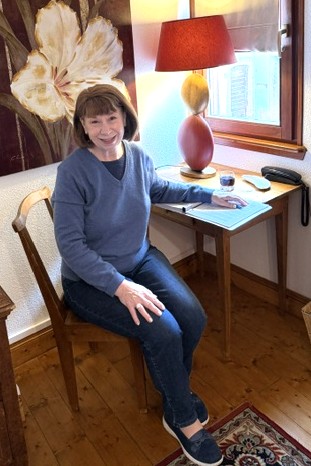
I’ve been editing Death at Brookhaven in hotel rooms across Europe this spring.
That sentence still surprises me when I say it aloud. There’s something quietly absurd — and quietly perfect — about sitting at a small desk in a centuries-old city, watching the light fall through a window I’ve never seen before, and working on a story set somewhere else entirely. But that’s the thing about research and writing: they don’t happen in separate rooms. For me, they’ve always happened in the same place at the same time.
The place is usually somewhere old. Somewhere that still remembers.
Portugal: The Weight of What Remains
Portugal stopped me the way a sentence sometimes stops you — unexpectedly, completely. I wasn’t looking for anything specific. I was simply walking, which is always the beginning of the real research.
What I found was a country that carries its history the way some people carry grief: quietly, and with enormous dignity. The tiles on the walls of Lisbon aren’t decorative. They’re a record. Every panel tells something — a saint, a battle, a ship leaving harbor that may never return. You stand in front of them and you feel the passage of time not as an abstraction but as a physical thing. It presses against your chest.
That feeling — that sensation of history as a presence rather than a fact — is what I try to put on the page. Portugal reminded me why I write the way I write. Not to report what happened, but to make you feel what it was like to be there when it did.
Bruges: A City That Stopped the Clock
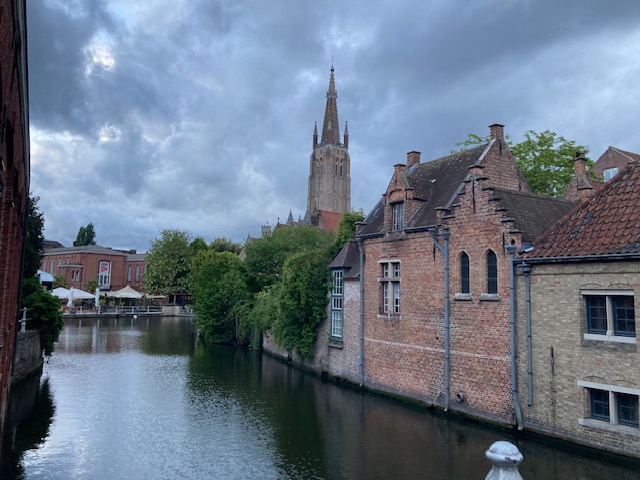
Bruges is one of the only places I’ve ever been that made me genuinely uncertain about what century I was standing in.
The canals don’t move quickly. The stone bridges are worn down the middle where centuries of feet have passed over them. The guild houses lean slightly toward each other across the water, the way old neighbors do. And the silence, particularly in the early morning before the tourists arrive, is the kind of silence that has texture. It’s not empty. It’s full of everything that happened there.
I found myself thinking about ordinary people — the ones who lived in those houses, who crossed those bridges on their way to work, who had no idea they were living inside what would one day be called a UNESCO World Heritage Site. They were simply living their lives. That’s always the discovery I’m looking for: the ordinary people inside the extraordinary moment.
Walking through Bruges is not background research. It is the research.
The Moselle River: Where Call of the Blackbird Lives
The Moselle Valley in France is the landscape behind Call of the Blackbird, and returning there after the book is published is a strange and moving experience.
The river is slower than I remembered. Or perhaps I was slower. The vineyards on the hillsides look exactly as they should — terraced, ancient, impossibly green in the late spring light. The villages are small and self-contained, the kind of places where the church is still the tallest building and the streets haven’t changed their names in four hundred years.
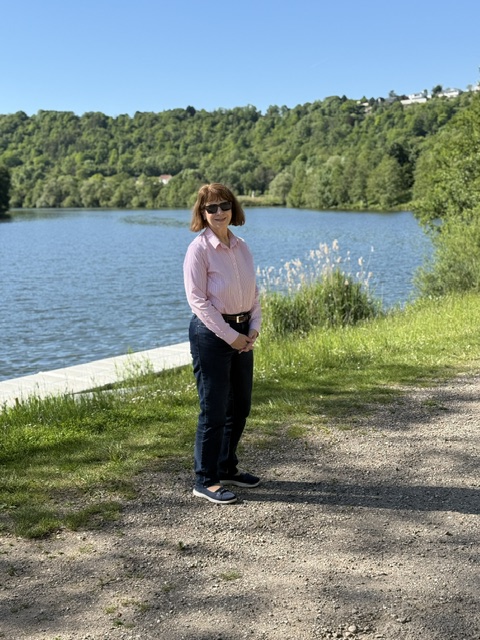
I stood on a bank of the Moselle and thought: this is what she saw. My character walked here. She looked at this same water, this same bending curve of the river. The history I researched in libraries and archives was suddenly standing right in front of me, and the sensation was something I genuinely hadn’t expected — a kind of recognition, as if I had been here before through someone else’s eyes.
That’s the gift of writing historical fiction set in real places. The places confirm the story. They tell you: yes, this was true. Yes, this is real. You got it right.
What Editing Feels Like in an Old City
There’s a particular quality to editing Death at Brookhaven in a European hotel room that I couldn’t have manufactured anywhere else.
The new book is set in a different world — different time, different landscape — but the work of editing is the same anywhere: you’re listening for the false note, the sentence that doesn’t ring true, the moment where you’ve told instead of shown. And somehow, sitting inside a building that is itself a hundred years old changes how carefully you listen. History isn’t theoretical here. It isn’t something you have to imagine. It’s the floor beneath your feet.
I don’t know how to explain this to someone who hasn’t felt it. The past becomes a companion. You work differently in its presence.
The Research That Can’t Be Found Anywhere Else
I read. I use archives, libraries, letters, diaries, maps, academic histories. All of that is essential — I couldn’t write what I write without it. But there is a category of knowledge that cannot be found in any of those places, and it only comes from being somewhere. From walking slowly. From sitting still and paying attention.
It’s the smell of old stone in the rain. The sound a canal makes at dawn. The particular quality of light over a river that has been called by the same name for a thousand years. The way a cobblestoned street vibrates differently under your feet than any other surface.
These things find their way into the writing and the readers notice them, even if they can’t name what they’re noticing. That’s when someone writes to me and says: I felt like I was there. That’s the whole thing. That’s what this work is for.
If you’ve read Call of the Blackbird and wondered how much of it was real — the answer is: more than you might expect. And the places are still there, still waiting, still quietly remembering everything.
Call of the Blackbird is available in paperback, Kindle, and audiobook wherever books are sold.