
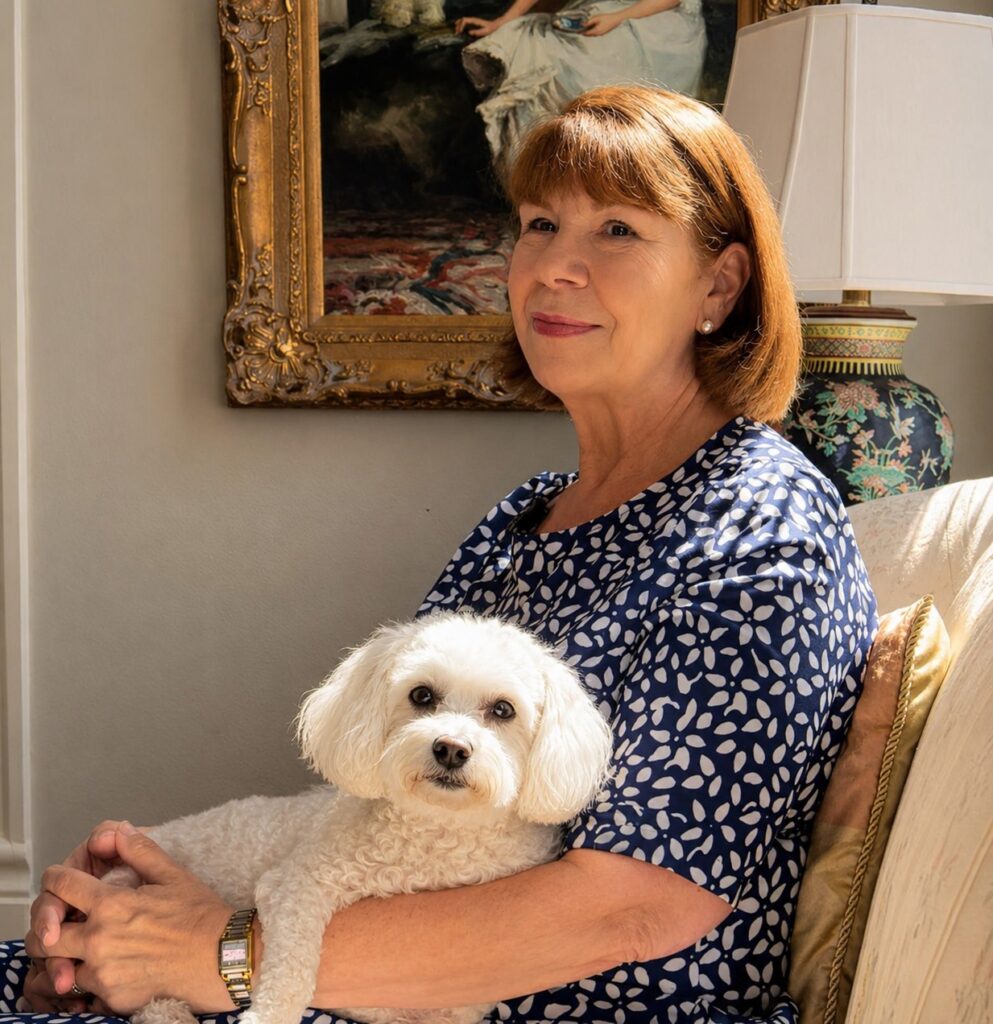
Button used to sleep on my lap as I sat at my desk for the entire time I worked on my debut novel, Call of the Blackbird. Not beside me. On me, curled up in my lap, so that I could feel the small, steady weight of him. He had a particular sigh he’d give when he settled in for a long afternoon, as if he already knew, better than I did some days, that this was going to take a while.
A year ago and after a long, happy life, Button died. And for a long time after, sitting at my desk felt empty. I didn’t try to fill it. Grief over a dog is its own quiet, slightly embarrassing thing to carry, the kind people don’t always know what to do with when you mention it out loud. But I have come to think that some of what I felt in that empty space is the real reason there is a dog in Death at Brookhaven at all.
What a Dog Does for a Story
A dog cannot lie. That single fact is worth more to a novelist than almost any other trait I could invent for a character. Every human in a story can withhold, deflect, perform a feeling they don’t have and hide one they do. A dog can only respond to what is actually happening in a room, which makes a dog one of the most honest instruments a writer has.
When a dog in a story goes still, or presses closer to its person, or refuses to walk into a particular room, the reader believes it instantly, because we have all watched a dog do exactly that and understood, before we could explain why, that something was wrong. A dog can carry tension a paragraph of description never could. It can also carry relief. A dog curling up in a patch of sun in the middle of a tense scene tells the reader, wordlessly, that this room is still safe, at least for now.
And a dog moves a heroine, literally and otherwise. It gets her out of the house on the morning she would rather stay in bed. It forces her into the garden, the stable yard, the lane at the edge of the property, simply by needing to be walked. Half the scenes I love most in fiction happen because a dog needed to go outside, and something was waiting out there that the story needed the heroine to find.
The Dogs Literature Has Never Forgotten
I think of Argos, waiting twenty years for Odysseus to come home, recognizing him instantly through a beggar’s disguise that fooled every human in the hall, and then, having done the one thing he lived for, quietly closing his eyes. Homer gives him only a few lines. They are some of the most devastating lines in the whole poem.
I think, too, of Greyfriars Bobby, the little Skye terrier said to have kept watch over his owner’s grave in Edinburgh for fourteen years, in all weather, until the whole city knew his name and fed him and finally could not let him be moved. Whether every detail of that story is precisely true the way a court record is true hardly matters. It has been carried faithfully for over a century because it tells us something we already suspected about loyalty, that it can outlast the person it was given to.
And I think of Jip, curled at Dora’s feet in David Copperfield, a small, foolish, entirely devoted presence in a book full of much larger griefs. Dickens didn’t need Jip to do anything dramatic. He only needed him to be there, faithfully, so the reader would feel the particular tenderness of a small life given completely to someone.
Tess, and Where She Really Came From
There is a dog in Death at Brookhaven (coming out in September). Her name is Tess, and I won’t say much about what happens to her or around her, because that belongs to the book and to the reader discovering it fresh.
But I will say this. Tess isn’t invented out of nothing. She’s built from a real dog, a large stray I rescued who needed a home more urgently than I had room to give her at the time. My sister Susan took her in without hesitating, and Tess has been thoroughly loved and thoroughly spoiled in her house ever since. I watched that sweet dog arrive injured, hungry, frightened and slowly heal to understand that no one was going to cast her out again. I don’t think I fully understood what I was watching until later, when I sat down to write a new book and a dog simply walked into one of the earliest scenes, uninvited, the way things do when you’re not paying close enough attention to stop them.
I think she walked in because Button had just walked out of my life, and some part of me needed somewhere to put that. Not to replace him. You don’t replace a “cute-as-a-button” dog like that. But devotion doesn’t only move in one direction, and it doesn’t disappear just because the particular animal who taught it to you is gone. It seems to look for somewhere else to land.
What the Empty Space at the Desk Taught Me
I’ve written a great deal about history being alive, about the past staying present in the rooms we think we’ve left behind. I didn’t expect a dog to teach me the same lesson, but he did. Button isn’t on my lap as I sit at my desk anymore. But something of what he gave me, that steady, uncomplicated certainty that I was worth waiting for through a long afternoon of work, found its way into a household at Brookhaven that badly needed a little of that same steadiness.
History is full of grand gestures. But so much of what actually holds a life, or a story, together is this smaller thing: someone, or something, willing to keep showing up, and a person willing to notice when they finally stop.
If you’d love more of this, the research, the reflections, and the occasional story about the dogs who’ve shaped my writing life, I’d love to have you in the Readers’ Circle. It costs nothing. It simply means you love a good story, on the page and off it.
You can join here: READERS’ CIRCLE SIGNUP
With love for the past, and for the ones who taught us what devotion looks like,
Nancy