
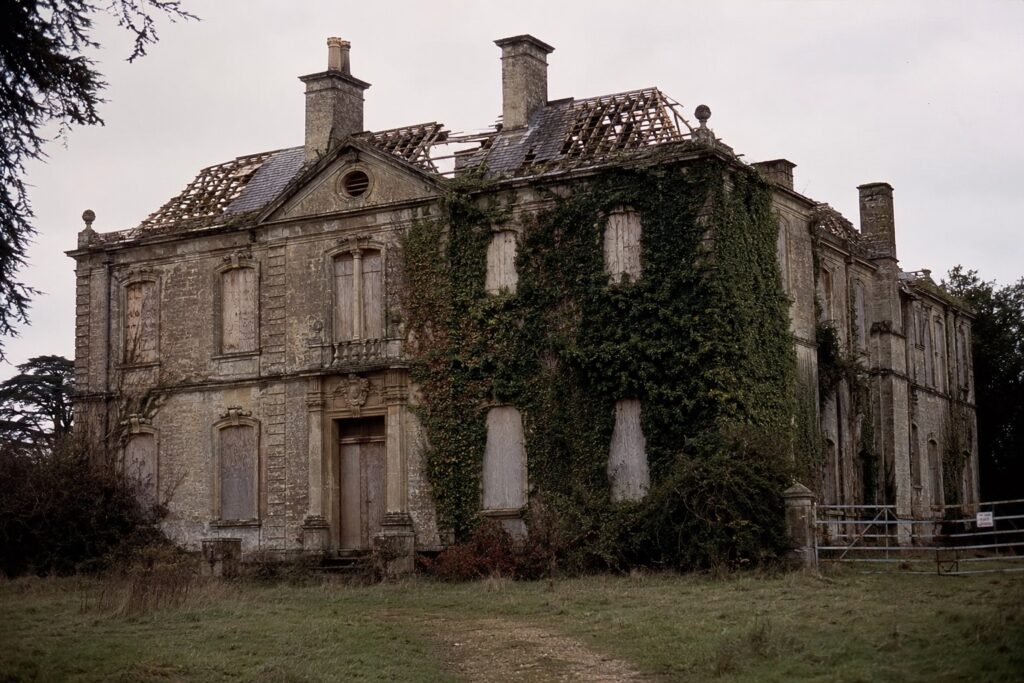
There is a photograph I keep coming back to. An English manor house in Oxfordshire, taken sometime in the early 1960s, roof half stripped of lead, windows boarded, ivy already reaching for the second floor. Twenty years earlier it had been requisitioned for the war effort, and the family who returned to it never quite recovered enough to save it. It was demolished not long after that photograph was taken. Somewhere between 1945 and 1970, England lost close to a thousand houses like it. I have spent time trying to understand why, and the answer has become one of the quiet undercurrents running through my research.
The Tax Bill That Arrived With the Coffin
By 1949, death duties on the largest estates in England had climbed to 80 percent. A family that had held land for three or four centuries could lose the great majority of its value the moment the current owner died. For a manor that existed as one interconnected system, house, farms, tenant cottages, woodland, that single tax bill often meant selling off the very land that had paid for the house’s upkeep in the first place. Once the land was gone, the house had no income left to lean on. It became a beautiful, aging structure with nothing behind it.
The Heirs Who Never Came Home
Every estate depended on a line of succession, a son groomed from childhood to inherit the responsibility along with the house. Two world wars broke that chain again and again. Younger sons who died at the Somme or over the Channel left estates to cousins who had never expected the burden and sometimes had no attachment to the place at all. I think often about those unexpected heirs, standing in a hall built for a family they barely knew, trying to decide whether duty to a house they didn’t choose was still duty at all. That tension, between obligation and identity, is exactly the kind of emotional truth that pulls me into a story.
A World That No Longer Ran on Land
For centuries, a manor’s wealth came from its farms, its tenants, its rents. By the 1960s, Britain’s economy had shifted decisively toward industry and, increasingly, toward the City. Agricultural rents that had once comfortably funded a household of thirty staff could no longer cover the cost of a leaking roof. The economics that had built these houses simply stopped existing, and no amount of family pride could argue with a ledger.
Nobody Left to Answer the Bell
Even families who kept their land often lost their houses for a simpler, more human reason: there was no one left to run them. Before the war, a manor might employ a dozen servants or more, an entire small economy of cooks, maids, gardeners, and grooms. After 1945, that world of service largely vanished. Young people who had gone to work in factories or joined the war effort discovered other options, and they took them. A house built to be run by twenty hands cannot be run by two, no matter how devoted the family living in it.
Culture Had Simply Moved On
Perhaps the hardest loss to quantify is the cultural one. By the 1960s, the aristocratic country house had become, in the eyes of many, a relic. A younger generation raised on postwar austerity and a rapidly modernizing Britain didn’t always share their parents’ reverence for ancestral piles. Some heirs walked away entirely, choosing London flats and ordinary lives over drafty halls and impossible expectations. I don’t think that’s a story about ingratitude. I think it’s a story about people trying to build lives that made sense in the world they actually lived in, not the one their grandparents had left behind.
What the Houses Left Behind
What strikes me most, researching this era, is how personal every one of these losses actually was. Behind every demolished manor is a family standing in a doorway making an impossible choice, a housekeeper packing up a kitchen she had run for thirty years, an heir walking through empty rooms and feeling the weight of everyone who came before him. These are not abstract statistics about postwar Britain. They are the ordinary people living through an extraordinary unraveling, and it is changing times like these that are precisely where I find many of the stories I want to tell.
This is the world I keep returning to in my research, and it is woven through the settings in Death at Brookhaven, where a house holds onto its secrets long after the family that built it has scattered. If you have ever stood in an old house and felt the weight of everyone who lived there before you, I think you will understand why I fell compelled to write about them.
Death at Brookhaven is coming in September 2026. Join the Readers Circle to be notified as Death at Brookhaven becomes available.
With love for the past,
Nancy