
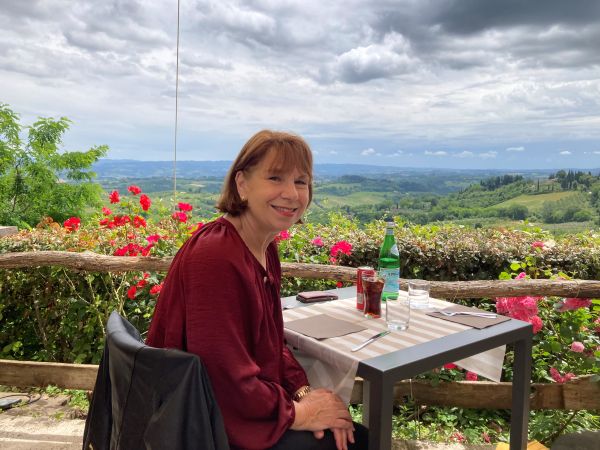
I did most of the final editing on Death at Brookhaven in places that were not my desk. My writing process included a hotel room with a view of a tiled rooftop. A café table that wobbled slightly no matter how I folded the napkin under its leg. The manuscript spread out beside a glass of diet Coke, I had bargained hard for every ice cube in it. (I’m from Texas. Ice is not optional.) The sturdy little hotel desk some days, a deck chair on the ship crossing the Atlantic from Portugal to Miami on others.
I was away for more than two months this summer, moving through Europe with a laptop, a notebook, and a book that was not quite finished. People sometimes ask if that was a distraction. The truth is closer to the opposite. It was the work.
Atmosphere Is Not Something You Invent
There is a version of writing historical fiction that happens entirely from memory and research, and it can be very good. But it can be hard for me to write a room I have not, in some sense, stood in. Not the exact room, not always the exact country, but something close enough that my body remembers what it felt like to be small inside a large old space, or cold in a stone hallway that no amount of history had warmed.
When I sat down to edit a scene set in a manor house this summer, I was often doing it a few hours from an actual manor house, or one very much like it. The light was the same light. The particular hush that settles over old buildings, the ones that have outlived everyone who first walked their floors, was right there, outside a window I could open. I did not have to imagine that hush. I only had to listen to it and write down what I heard.
Editing in Motion
Most of my editing this summer happened in hotel rooms, which sounds less romantic than it was. There is a discipline to working in a place that is not yours. Nothing is arranged the way you would arrange it. You cannot spread your notes across three different surfaces the way you might at home. You have one small table, a manuscript, and whatever quiet the day has given you, and you learn to make that enough.
I found the work sharpened by it. A scene either held up in an unfamiliar room with the sounds of a foreign street outside, or it didn’t. There was nowhere to hide behind the comfort of my own study. I would read a paragraph, look up at a rooftop I did not recognize an hour ago, and ask the question every scene has to survive: does this feel true, or does it only feel written?
The last stretch of that editing happened at sea, on the crossing home from Portugal to Miami. Seven days with nothing but water in every direction, and a manuscript that finally had my full attention. I have written before about what that crossing gave me in terms of quiet. What I have thought about more since is what it gave the book itself. An ocean has its own atmosphere, its own weather and light and long, patient silence, overheard conversations, and some of that found its way into how I finished Death at Brookhaven, even in scenes that never leave dry land.
What the Reader Actually Receives
None of this shows up on the page as a travelogue. Readers of Death at Brookhaven will not find hotel rooftops or ship railings. What they will find, I hope, is a world that does not feel assembled from an outline. A staircase that creaks the way staircases in old houses actually creak. A garden that smells like something specific rather than something generic. Weather that behaves the way weather actually behaves in the place the story is set.
That is what I mean when I say travel is not research for me so much as it is instrument tuning. The facts I could gather from any archive. What travel gives me is the pitch, the feel of a place in my own body, so that when I sit down to write it, or edit it, I am not reaching for an adjective. I am reporting something I have actually felt.
Bringing It Home
I am back at my own desk now, in my own chair, with Death at Brookhaven finished and out in the world. But I can still call up the rooftop from that hotel room, and the particular color the Atlantic turned in the last hour before dark. I suspect they will turn up again, in whatever comes next.
Since the book found its readers, one line keeps showing up in messages and reviews: “I felt like I was there!” That is exactly what I hoped for. Not that a reader would admire the research, but that they would forget, for a chapter or two, that they were reading at all.
If you have read Death at Brookhaven and felt like you were standing in those rooms with the characters, that is not an accident. That is two months of hotel rooms and one long, quiet ship crossing, all of it in service of a story I wanted to feel as real to you as it does to me.
Death at Brookhaven is available now in paperback and Kindle.